Choosing a cut
Why a marquise reads longer on the hand, why a cushion holds colour, and how the shape you choose changes the stone you need.
Shape changes what you see
Weight is not size. Two stones of the same weight can look quite different on a hand, because an elongated shape spreads that weight across a larger face while a deeper shape carries it out of sight below the setting.
This is why a marquise or an oval often reads larger than a round of the same weight, and why comparing stones by weight alone is the most common mistake a first time buyer makes.
Shape changes colour
Length concentrates colour. In a coloured stone, an elongated cut carries the colour along its axis, so a pale stone reads deeper and a strongly saturated one can read almost too dark.
The practical consequence is that a cut is chosen for the individual stone in front of you, not selected from a catalogue in advance. A pale sapphire and a deep one want different shapes.
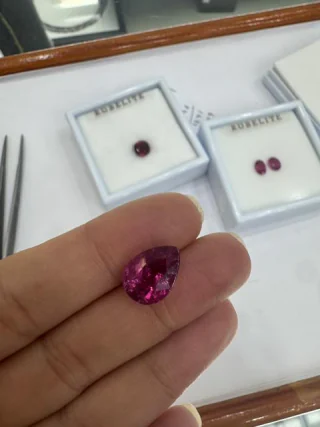
Shape changes the setting
Every point is a vulnerability. A marquise has two of them and a pear has one, and those points need a setting that protects them without hiding them, which is bench work rather than a decision made on paper.
A cushion or an oval has no points to protect, which is part of why they suit a life that includes doors, handbags and children.
Questions
- Which cut looks biggest for its weight?
- Elongated shapes such as marquise, oval and pear generally spread across a wider face than a round of the same weight, so they read larger on the hand. Depth is what decides it: weight carried below the setting is weight no one sees.
- Which cut is best for a coloured stone?
- It depends on the stone. An elongated cut deepens the apparent colour of a pale stone, while a strongly saturated stone often reads better in a shape that does not concentrate it further. The stone is chosen first and the cut follows.
- Are pointed cuts more fragile?
- The points are the vulnerable part. A marquise has two and a pear has one, and both are protected by how the piece is set rather than by the stone itself, so the setting matters more on these shapes than on a cushion or an oval.